
Which Business Structure is Right for You? A Beginner’s Guide to Company Registration in India
Confused about Company Registration in India? Compare Sole Proprietorship, LLP, OPC, and Private Limited Company to choose the right business structure.
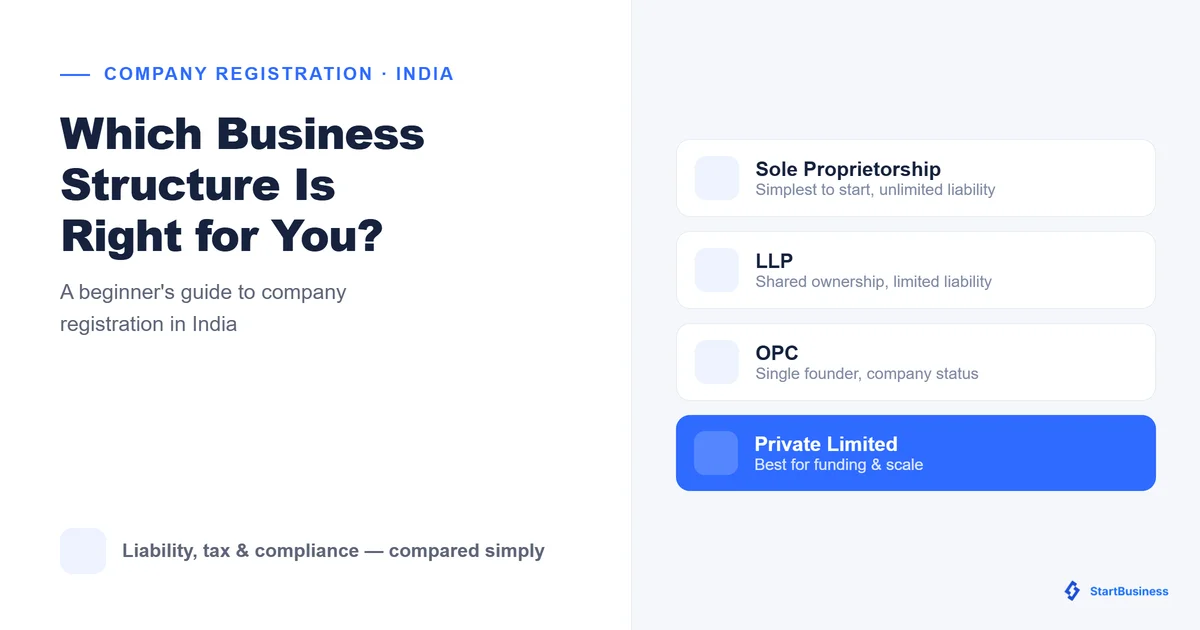
Choosing the right business structure is one of the most critical decisions when starting a business in India. It impacts everything — from taxes and compliance requirements to funding opportunities and personal liability. In this beginner’s guide to Company Registration in India, we’ll break down the most common business structures to help you decide which one suits your entrepreneurial goals.
Why Business Structure Matters?
The business structure you choose determines how your business will be taxed, how much personal liability you carry, and how easy it is to raise capital or bring in partners. It’s not just about compliance — it’s about setting your business up for long-term success. When considering Company Registration in India, selecting the correct structure can help you avoid unnecessary legal complications and operational challenges.
Overview of Popular Business Structures in India
1. Sole Proprietorship
Ideal for solo entrepreneurs, a sole proprietorship is the simplest form of business structure. It’s easy to set up with minimal compliance. However, the owner is personally liable for all debts and losses, and it lacks scalability and formal recognition under Company Registration in India.
2. Partnership Firm
Suitable for two or more individuals looking to run a business together. Partnerships are governed by the Indian Partnership Act, 1932. Though easy to form, they carry unlimited liability unless registered as an LLP. Partnership firms are commonly used for small businesses that do not want to go through the full process of Company Registration in India but still want to formalize their business.
3. Limited Liability Partnership (LLP)
An LLP provides the flexibility of a partnership with limited liability for partners. It’s ideal for professionals and small businesses wanting legal protection without the full corporate structure. Annual ROC filing is mandatory, and it is one of the most popular options under Company Registration in India for service-based firms.
4. One Person Company (OPC)
OPC is perfect for solo founders who want the benefits of a private limited company with limited liability. OPCs can raise capital, have better credibility, and enjoy corporate status while being managed by a single promoter. It’s a new-age solution under Company Registration in India introduced to support solo entrepreneurs.
5. Private Limited Company
A Private Limited Company is the most preferred structure for startups and growing businesses. It allows for investment, limits liability, and offers better compliance credibility. It requires at least two directors and regular ROC filings. Private Limited Companies dominate the landscape of Company Registration in India due to their adaptability and investor-friendly model.
6. Public Limited Company
Best suited for large businesses intending to raise capital from the public. Public companies have strict compliance and disclosure norms, require at least three directors, and are regulated heavily by SEBI and MCA. For businesses aiming for IPOs and large-scale funding, this structure under Company Registration in India is essential.
Factors to Consider When Choosing a Structure
Before proceeding with Company Registration in India, evaluate these key points:
- Number of owners/promoters
- Capital investment plans
- Risk and liability tolerance
- Compliance readiness
- Future scalability and funding needs
Each factor plays a vital role in determining the best legal structure for your enterprise.
Key Difference in Business Structures
This table highlights the crucial differences in common business structures in India, aiding user decision-making.
| Feature | Private Limited Company (PLC) | Limited Liability Partnership (LLP) | One Person Company (OPC) | Sole Proprietorship |
|---|---|---|---|---|
| Governing Act | Companies Act, 2013 | Limited Liability Partnership Act, 2008 | Companies Act, 2013 | No specific act (governed by various laws) |
| Legal Identity | Separate legal entity | Separate legal entity | Separate legal entity | No separate legal entity |
| Liability | Limited to shareholders' investment | Limited to partners' contribution | Limited to owner's investment | Unlimited (personal assets at risk) |
| Minimum Members | 2 Directors, 2 Shareholders | 2 Designated Partners | 1 Director, 1 Nominee | 1 Owner |
| Maximum Members | 15 Directors, 200 Shareholders | No upper limit for partners | 1 Owner | 1 Owner |
| Minimum Capital | No minimum capital requirement (earlier Rs. 1 lakh authorized capital) | No minimum capital requirement | No minimum capital requirement (earlier Rs. 1 lakh authorized capital) | No specific capital requirement |
| Fundraising Ability | Easy (equity shares, VCs, Angel Investors) | Difficult (cannot issue equity shares) | Difficult (cannot issue equity shares) | Limited (personal loans, self-funding) |
| Compliance Burden | High (annual returns, audits, board meetings) | Moderate (fewer compliance requirements than PLC) | Low (fewer compliance requirements than PLC) | Very Low |
| Taxation | Corporate tax (e.g., 22-30% + surcharge/cess) | Taxed at partner level (30% on profits) | Corporate tax | Individual income tax slab rates |
| Credibility | High | Moderate | Moderate | Low |
| Ideal For | Startups, scalable businesses, those seeking external investment | Professionals, small/medium businesses, service sector | Solo entrepreneurs seeking limited liability | Very small businesses, individual professionals |
Still Unsure? Use Our Business Structure Tool
If you're still unsure about which structure fits your needs, visit StartBusiness and use our free Business Structure Selector Tool. Answer a few simple questions and get expert-backed suggestions instantly. It’s designed to simplify your journey toward company registration in India with practical insights.
Conclusion
Choosing the right business structure is a strategic move — not just a legal formality. It lays the foundation for your business’s growth, compliance, and financial future. When planning for Company Registration in India, it’s crucial to align your structure with your business vision. Take the time to assess your goals, consult with professionals, and make informed decisions to start your business the right way.
Frequently Asked Questions
What business structure do I choose?
The right business structure depends on your business goals, number of owners, funding plans, and liability preferences. A sole proprietorship is suitable for individuals, an LLP works well for professionals and partnerships, while a Private Limited Company is the best choice for startups planning to grow or raise investment.
Which business structure is the easiest to start?
A Sole Proprietorship is the easiest business structure to start in India. It requires minimal paperwork, low compliance, and can usually begin with GST registration or a Shop and Establishment licence, depending on your business type and location.
What is the cheapest business structure?
A Sole Proprietorship is generally the cheapest business structure in India because it has low registration costs and minimal compliance requirements. However, if you want limited liability and better business credibility, an LLP or One Person Company (OPC) may offer better long-term value.
Which business structure is right in India?
There is no single best business structure in India. A Sole Proprietorship suits small businesses, an LLP is ideal for professionals and partnerships, an OPC works for solo entrepreneurs, and a Private Limited Company is best for startups seeking growth, investment, and limited liability.
Which business type is the most difficult to start?
A Public Limited Company is generally the most difficult business structure to start because it has stricter legal requirements, higher compliance obligations, multiple directors, and detailed regulatory reporting. It is mainly suitable for large businesses planning to raise funds from the public.
What business has a 90% success rate?
No business has a guaranteed 90% success rate. Success depends on factors such as market demand, financial planning, execution, and management. Choosing the right business structure, maintaining legal compliance, and validating your business idea can significantly improve your chances of long-term success.
Related Services You Might Need
Based on this content, these services might be helpful for your business: