
Partnership Firm Registration in India
We draft your partnership deed, get it executed on stamp paper and register the firm with your state's Registrar of Firms, with a named CA or CS on your project.
Starter
You’re registered. Pick this if you just need the partnership documented.
- Partnership deed drafted with custom clauses
- Profit sharing, capital and exit terms defined
- Deed executed on stamp paper
- Notarisation arranged
- Registration with the Registrar of Firms
- Firm PAN
- Firm TAN (if applicable)
- A named CA or CS on your project
Launch
You’re operational. Pick this if you’ll be invoicing clients from day one.
- Everything in Starter — deed, firm registration, PAN, TAN (if applicable)
- GST registration (subject to applicability)
- Professional tax registration (subject to applicability)
- MSME Udyam registration
- Shop Act registration (subject to applicability)
- A named CA or CS on your project
Growth
You’re filed through year one. Pick this if you don’t want to think about filings for a year.
- Everything in Launch — deed, firm registration, all registrations
- Tax compliance, year one
- Financial statements prepared
- Firm income tax return filed
- Partner remuneration and interest computed
- A named CA or CS on your project
Our annual tax compliance service is ₹9,999 a year on its own. Included here.
GST return filing and tax audit, where applicable, are quoted separately.
Note: Stamp duty, the Registrar of Firms fee and other government charges are paid at actuals; 18% GST applies to our fee only. GST, professional tax and Shop Act registration depend on your turnover, state and type of business. The cost breakdown below shows a worked example.
Cost of Registration of a Partnership Firm
Your total is made up of four parts. Only the first two are ours.
Example: Starter is ₹3,999 + ₹720 GST = ₹4,719, plus stamp duty and the Registrar's fee for your state. We send the full figure in writing before you pay.
Partnership Firm Registration at a Glance
- What it is
- A relationship between persons who agree to share the profits of a business carried on by all of them, or any of them acting for all (Section 4, Indian Partnership Act, 1932). The partnership deed records the terms.
- Liability
- Every partner is jointly and severally liable for the firm's debts and obligations incurred while they are a partner, and that liability can reach personal assets. Each partner can also bind the firm when acting in its ordinary business (mutual agency). A partnership firm does not give limited liability.
- Legal status
- A firm is not a separate legal entity the way an LLP or company is. It is the collective name of its partners, although it is assessed as a separate unit for income tax.
- Where it is registered
- With the Registrar of Firms of the state where the firm's principal place of business is located, not with the Ministry of Corporate Affairs (MCA). There is no certificate of incorporation for a partnership firm; the Registrar records the firm in the Register of Firms.
- Application
- A statement under Section 58 of the Act, signed by all partners, in the form your state prescribes. Form names differ by state. In Maharashtra the application is Form A, raised on the Registrar of Firms portal and followed by submission of the signed documents to the Registrar's office.
- Partners
- Minimum two. The maximum is set under the Companies Act, 2013 and its rules (currently 50). Individuals and companies can be partners; another firm or an HUF as such cannot.
- Firm name
- Your choice, but it cannot use words such as Crown, Emperor, Empire, Imperial, King, Queen or Royal, or words suggesting government sanction, without state government consent.
Is Partnership Firm Registration Compulsory?
Not under the central Act. Partners can form a firm by deed and run it without registering. Registration is still the practical default, because Section 69 of the Indian Partnership Act, 1932 restricts what an unregistered firm can do in court.
If the firm is unregistered, a partner cannot sue the firm or the other partners to enforce rights arising from the partnership deed or the Act, and the firm cannot sue a third party to enforce a contract. The firm can still be sued, and some claims fall outside Section 69, such as a suit for dissolution and accounts. Some states have amended the Act, so we confirm the position for your state before you sign.
Partnership Firm vs LLP vs Private Limited Company
No structure is better for everyone. If limited liability matters more than the lowest compliance cost, see LLP registration. Planning to raise investment? See private limited company registration. Going it alone? Compare one person company and sole proprietorship registration. If a proposed partner is an NRI or a foreign national, FEMA rules apply and some cases need prior approval; we check this before the deed is drafted. Still unsure? Take the business structure quiz or see our partnership firm examples.
Who a Partnership Firm Suits
A partnership firm works best when two or more people will run the business together, want low compliance, and are comfortable with personal liability.
Family businesses
Family members who want profit shares, roles and succession written down without the compliance load of a company.
Trading and distribution
Wholesale, retail and import-export businesses that run on working capital and want lean annual compliance.
Professional practices
CAs, architects, consultants and similar professionals practising together. Your professional body may have its own rules on firm structure and names, so check them first.
Agencies and service businesses
Design, marketing, IT and advisory firms with two or more owners who split client work and profits.
Contracting and small manufacturing
Partners pooling capital for equipment and sharing operations. Check whether the tenders or clients you target accept partnership firms.
Why StartBusiness for Partnership Firm Registration
Named CA or CS on your file
One qualified professional from the first call to the final registration.
Deed written for your business
Custom clauses on capital, profit, remuneration and exit, not a downloaded template.
Fixed fee, actuals in writing
Government fees and stamp duty itemised before you pay.
Based in Maharashtra, filing across states
We handle the Maharashtra Registrar of Firms process from our Pune office and confirm each state's rules before filing.
How Long Does Partnership Firm Registration Take?
The deed and PAN are within our control; the Registrar's review is not, and it varies by state and office workload. We give you a written timeline when we confirm scope, and we never promise an approval date on the Registrar's behalf.
Documents Required for Partnership Firm Registration
The final checklist depends on your state and the Registrar's office. These are the documents we usually ask for; we send the confirmed list for your state at the start.
What You Get:
Full-Service Partnership Firm Setup
You send the documents. We prepare, file and follow up until your firm is registered.
You receive
- Signed, stamped and notarised partnership deed
- Registration acknowledgement from the Registrar of Firms
- Firm PAN, and TAN if applicable
- GST, professional tax, Udyam and Shop Act registrations (Launch and Growth), subject to applicability
- Year-one financial statements and firm income tax return (Growth)
We prepare and file
- Deed drafted around your capital, profit and exit terms
- Stamp duty computed for your state
- Registration application filed with the Registrar of Firms
- Replies to any Registrar queries
- PAN application for the firm, and TAN where applicable
Your Registration, Step by Step
A clear timeline from document upload to certificate — no guesswork, no waiting in the dark.
Step 1
Free consultation and written scope
We confirm a partnership suits you, list the documents and send our fee in writing with government charges shown separately.
Step 2
Documents and partner terms
You share partner KYC, the business address and the terms you have agreed: capital, profit ratio, roles and exit.
Step 3
Deed drafted
We draft the deed and revise it with you until every partner is happy with it.
Step 4
Deed executed
Partners sign on stamp paper of the value your state requires. We arrange notarisation.
Step 5
Registration filed
We prepare the state application and file it with the Registrar of Firms, with physical submission where your state requires it.
Step 6
Registrar review
We answer any queries. Once the Registrar is satisfied, the firm is entered in the Register of Firms.
Step 7
PAN, TAN and other registrations
We apply for the firm's PAN, TAN if applicable, and the other registrations in your plan that apply to your business.
Partnership Deed Drafting and Registration
Three steps often get mixed up. Drafting the deed sets out the terms. Executing it means the partners sign it on stamp paper of the value your state requires, and we arrange notarisation. Registering the firm is a separate filing with the Registrar of Firms. A deed can exist without the firm being registered, but not the other way round.
Every deed we draft is written for your business. A generic partnership deed format downloaded in Word misses the clauses that cause disputes later, and it is not the government registration form either. The deed usually covers:
- Partner names, addresses and PAN
- Firm name, nature of business and place of business
- Capital each partner contributes, and in what form
- Profit and loss sharing ratio
- Each partner's role and authority, including who operates the bank account
- Partner remuneration, interest on capital and drawings
- Admission, retirement, death or exit of a partner
- How disputes are resolved
- Dissolution and settlement of accounts
The remuneration and interest clauses matter for tax: payments to partners are deductible for the firm only within the limits of income-tax law and only if the deed authorises them. The Growth plan computes these amounts in year one.
MSME (Udyam) Registration for a Partnership Firm
A partnership firm can register under Udyam if it meets the investment and turnover limits for a micro, small or medium enterprise. Udyam is a separate registration from your firm registration; registering the firm does not make it an MSME automatically.
Udyam registration is free on the official Udyam portal. It is included in our Launch and Growth plans as filing assistance, and also available on its own through our MSME registration service. Scheme benefits such as priority lending depend on each scheme's own eligibility conditions.

Not sure a partnership is right? Let's talk.
Tell us who the partners are and where the business will run. On a free 15-minute call, a CA will confirm whether a partnership firm or an LLP suits you, list the documents for your state and send the fee in writing.
Talk to an ExpertFrequently Asked Questions
Got questions? Find quick, expert answers to everything you need to know before getting started
Not under the Indian Partnership Act, 1932. A firm can operate unregistered, but Section 69 then stops the firm from suing third parties to enforce contracts and stops partners suing the firm or each other over partnership rights. Some states have amended these rules, so check your state.
Draft and sign the partnership deed on stamp paper, then file the registration application with your state's Registrar of Firms. Many states accept the application online, but some, including Maharashtra, also need signed documents submitted at the Registrar's office. We handle both parts.
Usually PAN, identity and address proof and a photo for each partner; a rent agreement or ownership proof, utility bill and owner's NOC for the business address; and the executed partnership deed. Your state may ask for more, so we confirm the list first.
The deed is the written agreement between partners: capital, profit ratio, roles, remuneration, exit and dispute resolution. A Word template is a starting point at best. It is also not the government registration form; the state form is a separate application, such as Form A in Maharashtra.
Our fee is ₹3,999, ₹7,999 or ₹12,999 depending on the plan, plus 18% GST on that fee. Stamp duty on the deed and the Registrar of Firms fee are extra at actuals and vary by state. We send the full amount in writing before you pay.
Deed drafting and PAN are quick once documents are complete. The Registrar's review takes longer and varies by state and office workload. We give you a written timeline when we confirm scope, and we do not promise an approval date on the Registrar's behalf.
In a partnership firm, partners have unlimited personal liability and the firm is registered with the state Registrar of Firms. An LLP is a separate legal entity registered with the MCA, and partners' liability is limited to their contribution, at the cost of more annual filings. See our LLP registration page.
Yes, if it meets the MSME investment and turnover limits. Udyam is a separate, free registration on the government portal and is not granted automatically when the firm is registered. Our Launch and Growth plans include filing it for you.

“StartBusiness made our LLP registration incredibly simple. They handled all legal requirements and paperwork efficiently. Highly recommended for any new founders.”
Mr. Hemant Patil
Apaha Institute Of Construction Project Management LLP
“StartBusiness made our LLP registration incredibly simple. They handled all legal requirements and paperwork efficiently. Highly recommended for any new founders.”
Mr. Hemant Patil
Apaha Institute Of Construction Project Management LLP
Blogs & Guides
Explore practical guides, compliance checklists, and expert tax insights written by CAs to help you make smarter business decisions.

GST Registration Turnover Limit in India: Thresholds, Eligibility & Rules
Do you need GST registration? Learn the ₹20 lakh & ₹40 lakh turnover limits and when registration is mandatory.

Presumptive Taxation in India: Sections 44AD, 44ADA & 44AE
Confused about presumptive taxation? Learn Section 44AD, 44ADA & 44AE with eligibility and tax details.
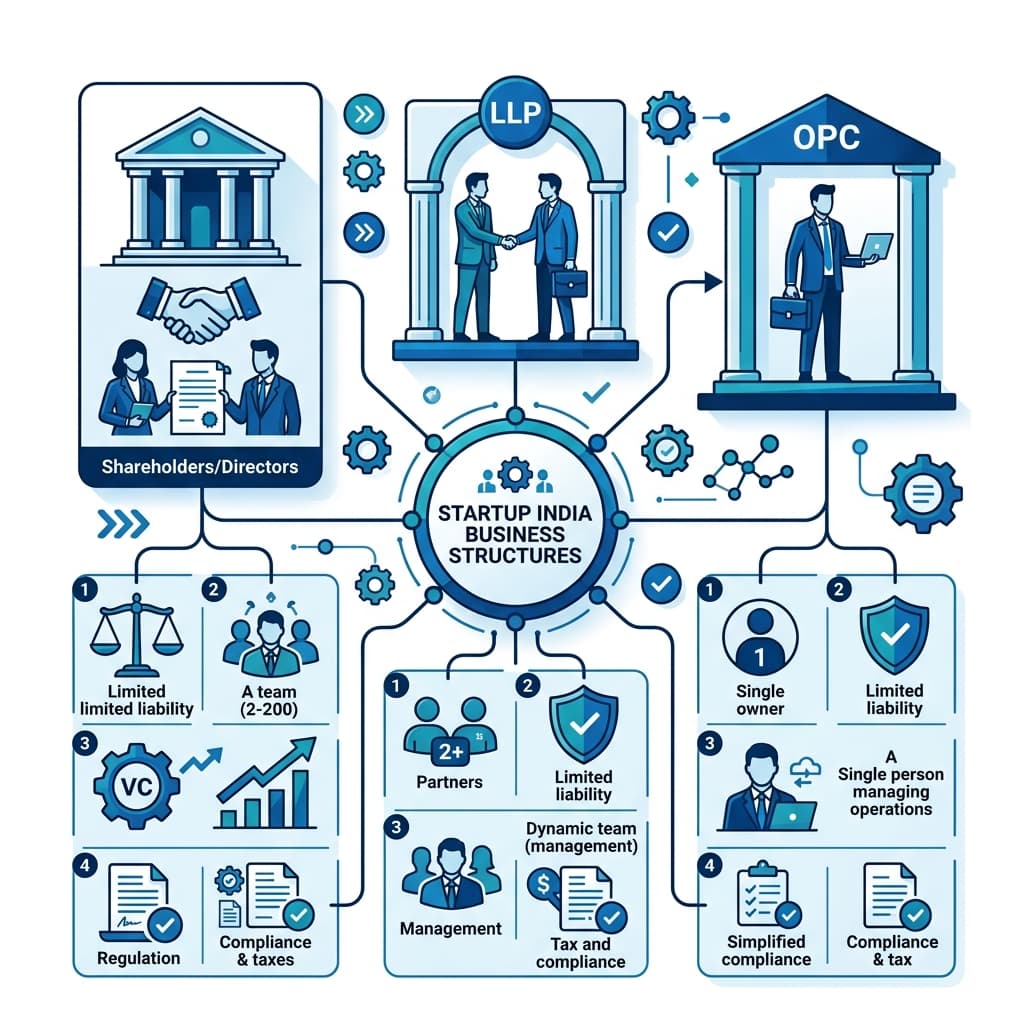
How Much Does It Cost to Register a Company in India?
Government fees, professional fees and hidden costs of registering a Private Limited Company, LLP or OPC.
Official sources: Ministry of Corporate Affairs (MCA) · Income Tax Department
Legal requirements on this page were checked on 13 October 2026 against the Indian Partnership Act, 1932 and the Udyam Registration portal. Stamp duty, Registrar fees and procedures are set by each state and change; we confirm current requirements before every filing. This page is general information, not legal advice for your situation.